(For Tracy Michele, who always reads them first.)
Showing posts with label 19th-century painting. Show all posts

Thursday, April 24, 2014

Sky's the Limit (originally entitled "A Little Bit of Sky")

(at The Morgan Library and Museum, New York City)

By ROBERT EDWARD BULLOCKSpecial to the Sun | April 24, 2014

Though it seems obvious today, it was only after the mid-1700s that artists began painting directly from nature in the plain light of day -- a radical evolution at the time. Working outside the studio, painters were challenged to quickly capture the changes in light, clouds and atmosphere in the natural world around them.

Termed "plein air" by the French, this practice of working outdoors called for small, portable equipment and materials. The practice of oil sketching on paper was advantageous. Though the intention may have been to develop these small studies into larger works back in the studio, we value them today for their own merits.

(Read the entire review at The New York Sun.)


Eugène Isabey (1803-1886), 'Sunset on the Normandy Coast,' Oil on paper, mounted on canvas. 
Thaw Collection, jointly owned by the Metropolitan Museum of Art and the Morgan Library & Museum; gift of Eugene V. Thaw, 2009.


Johan Christian Dahl (1788–1857), 'Cloud Study,' Oil on paper.
Thaw Collection, jointly owned by the Metropolitan Museum of Art and the Morgan Library & Museum; gift of Eugene V. Thaw, 2009.


Jean-Michel Cels (1819–1894), 'Cloud Study.' Oil on cardboard.
Thaw Collection, jointly owned by the Metropolitan Museum of Art and the Morgan Library & Museum; gift of Eugene Thaw, 2009.

Sunday, April 6, 2014

Gauguin the Primitive

(The New-York Historical Society)

"Gauguin: Metamorphosis," presenting nearly 160 works reassessing the unusual career of Paul Gauguin, is, surprisingly, the Museum of Modern Art's first major exhibition to focus solely on the self-taught and influential 19th-century painter.

Gauguin's alchemical use of color and simplified forms would go on to greatly impact the Symbolist and Modern art movements. Viewing the exhibit one wonders what to make of the man, heralded by many as a great painter and disparaged by as many others as a retrograde.

(Read the entire review at The New York Sun.)


Paul Gauguin, "Mata Mua (In Olden Times)," 1892. (Carmen Thyssen-Bornemisza Collection, Madrid)

Paul Gauguin, "Tahitian Woman with Evil Spirit (recto)," c. 1900. (Private collection.)

                       ^ Paul Gauguin, "Ovri (Savage)," 1894. (Private collection.)

Friday, July 19, 2013


(Metropolitan Museum of Art, Gallery 828 – Modern & Contemporary Art Collection. Notes of July 18, 2013)
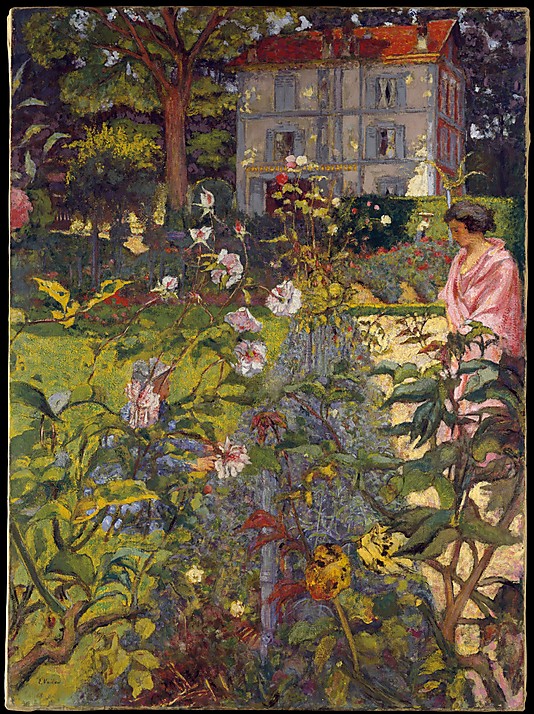
Re. Garden at Vaucresson by Edouard Vuillard: There is so much in this painting that fascinates. The sense of density and build-up, of thickness and tangle, which must surely result, in part, from the actual working technique, merges in a sense with the imagery itself. The high summer growth and quiet sunny heat of a private garden is brought forward and presses against the eye with an almost tapestry-like effect. Vuillard effectively cuts the sharpness of his high-keyed, modern palette by applying color over color, allowing the ground and subsequent paint layers to lend themselves, in total, to a more subdued effect. What, on its own, would be a rather acidic yellow-green is, instead, an intricate web of brushwork of muddy yellows, lime greens, and raw siennas, and in the right quarter of the image, a soft (nickel titanium?) butter yellow, quieted down and controlled with dull pinks and browns. Elsewhere, the effect of dappled sunlight and strong, cool shadows give definition to space and forms.
There’s a trick, of sorts, to this. The broken, rough edges of forms and shimmering touches of color all transmit the sense of sunshine and warmth. The plant growth in the foreground is formed with larger, bolder shapes and brushwork, bringing these forms closer to us. The lilac hedge that vertically divides the bottom half of the picture plane is a dense network of cool and warm violets, almost dusty purple in the shadows, and rising to grays that touch upon bluish-green in the sunlight. Getting up close to it, there is an almost disorienting handling of the brush here, like crewel-work.

Vuillard Garden
Garden at Vaucresson. Tempera (distemper) on canvas. 1920, reworked in 1926, 1935, 1936. Edouard Vuillard (French, b.1868-d.1940)

Wednesday, April 24, 2013

(Metropolitan Museum exhibition - The Path of Nature: French Paintings  from the Wheelock Whitney Collection, 1785-1850.) [Notes from April 11, 2013] Re. The Giralda, Seville by Adrian Dauzats: without laboring over minute details, Dauzats gives us indications of various shifts in the color of masonry; the cobalt blue of the sky shows up in the shadows, especially effective where it meets up against the soft cream-colored plaster of the upper structures; soft edges, and allowance for how the trailing of the brush suggests surfaces, are all things I have to learn from as a painter. A really fine sense of balance between the general and the specific creates all these beautiful little forms.

^ The Giralda, Seville. Oil on paper, laid down on canvas. ca.1836/37. Adrien Dauzats (b.1804-d.1868). 


Re. The Gate to the Temple of Luxor by Antoine-Xavier-Gabriel de Gazeau: a humid sky shifts between subtle shifts of whitish hues --- slightly gray blue, white, slightly yellow ochre white.

^ The Gate to the Temple of Luxor. Oil on paper, laid down on canvas. 1836. Antoine-Xavier-Gabriel de Gazeau, comte de La Bouëre (b.1801-d.1881).


Re. Cloud Study (Distant Storm), by Simon Denis: For most of the cloud's edges, the end of the brush was allowed to point outward, creating a feathery edge, instead of using the side of the brush to create a hard edge; a huge amount of sky and cloud formation is held within these small measurements (maybe 8x10"?).

^ Cloud Study (Distant Storms). Oil on paper. ca.1786-1806. Simon Denis (b.1755-d.1813).


Re. Mountainous Landscape at Vicovaro, by Simon Denis: Simon Denis is perfect; straight forward and direct with a keen sense of tone;  all the air and light and grandeur of the place fills his little paintings.
"Each day he painted or drew on the spot, always in a different place; and, in this fashion, he learned, as he himself said, to make studies by making pictures, and to make pictures by making studies." - Joseph Bidauld, french painter, b.1758-d.1846.

^ Mountainous Landscape at Vicovaro. Oil on paper.  ca.1786-97. Simon Denis (b.1755-d.1813).


Re. View in the Gardens of the Villa d'Este, by Léon Pallière: simplicity; all hues toned down (no #1 tone --- pure white); I have read of palettes which included no blues but, rather, black serves the place of it with the very lightest gray (it would need to be a cool black then, not a warm black); this could be an example; how much we are told about the pool's structure in the foreground with only a few simple shapes, carefully calibrated tones, and the drag of the brush; again, no sharp edges, no straight edges, no hard angles; imperfections aid in description and create naturalness.

^ View in the Gardens of the Villa d'Este. Oil on paper, laid down on canvas. ca.1814-17.  Léon Pallière (b.1787-d.1820).


Re. Mountainous Landscape with Bridge, by Eugène-Joseph Verboeckhoven: dramatic use of light hitting pale, massive cliff wall places our attention on the foreground, framed dramatically on either side in other shadowed, steep formations, with masonry protruding like a ridge up the right bank; this light is repeated back further, at its source --- the early evening sun, soft and warm with some faint rosy tone, behind the foreground outcrop; evening light quickly transferring to pale baby blue but the shift is so subtle; distant hills dissolve away from their nearer sibling into soft soft violet grays with no edge, no interruption, the light melts ridges where atmosphere lay.

Mountainous Landscape with Bridge. Oil on paper, laid down on canvas. ca.1820s? Eugène-Joseph Verboeckhoven (b.1798-d.1801)