(For Tracy Michele, who always reads them first.)

Friday, April 25, 2014

Family Reunion

(at The Metropolitan Museum of Art, New York City)

By ROBERT EDWARD BULLOCK, Special to the Sun | April 25, 2014

For the first time in nearly 230 years, a family of six from Madrid is spending time together. In "Goya and the Altamira Family" the Metropolitan Museum of Art unites a set of portraits commissioned by the Count of Altamira, the director of what is now the Banco de España. This small grouping highlights some of Goya's peculiar grandeur and melancholy.

Francisco José de Goya y Lucientes, b.1746, was a fabulously successful court painter in Madrid, a portraitist of the royal family and the Spanish aristocracy. Numbered among the last of the Old Masters while being the premier Modernist, his work possesses the repeating minor chord of a somber melody, as even his bright colors hold some tone of lament.

(Read the entire review at The New York Sun.)


^ Goya (Francisco de Goya y Lucientes), 1746-1828, "Vicente Joaquín Osorio Moscoso y Guzmán, 12th Conde de Altamira (1756-1816)," 1787 (Banco de España, Madrid.)


^ Goya (Francisco de Goya y Lucientes), 1746-1828, "Maria Ignacia Álvarez de Toledo, Condesa de Altamira and Her Daughter, MaríaAgustina," 1787-88 (The Metropolitan Museum of Art, Robert Lehman Collection)


^ Goya (Francisco de Goya y Lucientes), 1746-1828, "Manuel Osorio Manrique de Zuñiga (1784-1792)," 1787-88               (The Metropolitan Museum of Art, The Jules Bache Collection)


Goya (Francisco de Goya y Lucientes), 1746-1828, "Vicente Osorio de Moscoso, Count of Trastamara" (Private Collection)


^ Esteve Y Marques "Portrait of Juan Maria Osorio" (Cleveland Museum of Art)

Thursday, April 24, 2014

Sky's the Limit (originally entitled "A Little Bit of Sky")

(at The Morgan Library and Museum, New York City)

By ROBERT EDWARD BULLOCKSpecial to the Sun | April 24, 2014

Though it seems obvious today, it was only after the mid-1700s that artists began painting directly from nature in the plain light of day -- a radical evolution at the time. Working outside the studio, painters were challenged to quickly capture the changes in light, clouds and atmosphere in the natural world around them.

Termed "plein air" by the French, this practice of working outdoors called for small, portable equipment and materials. The practice of oil sketching on paper was advantageous. Though the intention may have been to develop these small studies into larger works back in the studio, we value them today for their own merits.

(Read the entire review at The New York Sun.)


Eugène Isabey (1803-1886), 'Sunset on the Normandy Coast,' Oil on paper, mounted on canvas. 
Thaw Collection, jointly owned by the Metropolitan Museum of Art and the Morgan Library & Museum; gift of Eugene V. Thaw, 2009.


Johan Christian Dahl (1788–1857), 'Cloud Study,' Oil on paper.
Thaw Collection, jointly owned by the Metropolitan Museum of Art and the Morgan Library & Museum; gift of Eugene V. Thaw, 2009.


Jean-Michel Cels (1819–1894), 'Cloud Study.' Oil on cardboard.
Thaw Collection, jointly owned by the Metropolitan Museum of Art and the Morgan Library & Museum; gift of Eugene Thaw, 2009.

Sunday, April 6, 2014

Gauguin the Primitive

(The New-York Historical Society)

"Gauguin: Metamorphosis," presenting nearly 160 works reassessing the unusual career of Paul Gauguin, is, surprisingly, the Museum of Modern Art's first major exhibition to focus solely on the self-taught and influential 19th-century painter.

Gauguin's alchemical use of color and simplified forms would go on to greatly impact the Symbolist and Modern art movements. Viewing the exhibit one wonders what to make of the man, heralded by many as a great painter and disparaged by as many others as a retrograde.

(Read the entire review at The New York Sun.)


Paul Gauguin, "Mata Mua (In Olden Times)," 1892. (Carmen Thyssen-Bornemisza Collection, Madrid)

Paul Gauguin, "Tahitian Woman with Evil Spirit (recto)," c. 1900. (Private collection.)

                       ^ Paul Gauguin, "Ovri (Savage)," 1894. (Private collection.)

Monday, March 31, 2014

Birds of a Feather (originally entitled "Where Have You Gone, John Audubon?"

(The New-York Historical Society)

Orson Wells once remarked that Chaucer's England was a world where the sky was a little bluer and the hay a little sweeter. The same can be said of John Audubon's America.

In "Audubon's Aviary: Parts Unknown," the second of a three-part series, The New-York Historical Society continues to celebrate the career of the French-born American naturalist, showcasing watercolors by his own hand for the historic double-elephant-folio print edition of The Birds of America (1827-38), engraved by Robert Havell Jr., alongside other related works from the series.

(read the entire review at The New York Sun online)


^ "Golden Eagle (Aquila chrysaetos), Havell pl. 181." (1833)
(The New-York Historical Society)


^ "Great Blue Heron (Ardea herodias), Study for Havell pl. 211, 1821." (1834)
(The New-York Historical Society)


^ "Black-throated Mango (Anthracothorax nigricollis), Study for Havell pl. 184." (ca. 1832)
(The New-York Historical Society)


^ "Wood Duck (Aix sponsa), Study for Havell pl. 206, 1821. " (ca. 1825)
(The New-York Historical Society)


"Atlantic Puffin (Fractercula arctica), Study for Havell pl. 213." (1833)
(The New-York Historical Society)

Saturday, March 8, 2014

Patriarchs of the Pentateuch

(The Cloisters Museum and Gardens, Ft Tryon Park, NYC)

By ROBERT EDWARD BULLOCKSpecial to the Sun | March 8, 2014

Once in 835 years qualifies as a rare event, and for the first time since their creation in 1178 six very fine and incredibly beautiful stained glass windows are on display outside of England's Canterbury Cathedral.

With "Radiant Light: Stained Glass from Canterbury Cathedral," The Cloisters in Fort Tryon Park, Manhattan, continues to celebrate its 75th anniversary. Situated on the cliffs of northern Manhattan overlooking the Hudson River and the Palisades, The Cloisters seems centuries-removed from modern times and is the ideal setting for this small exhibit.

(Read the entire review at The New York Sun.)

              
^ "Abraham" from the Ancestors of Christ Windows, Canterbury Cathedral, England, 1178-80 (© Robert Greshoff Photography, courtesy Dean and Chapter of Canterbury)

Saturday, February 22, 2014

Very BIG Pictures

(New York Academy of Art)

By ROBERT EDWARD BULLOCKSpecial to the Sun | February 22, 2014

Works of art are the result of decisions made by the artist, many of which are easy enough to notice right away. Color is one obvious example. But the scale of a work, unless it be unusually small or large, is easy to overlook. Outsized scale alerts us to an important decision made at the outset, affecting everything.

In the New York Academy of Art’s “The BIG Picture,” the grand scale of the seven works on display is incredibly commanding, overpowering the space about them and bearing down on the viewer. The sheer physicality of them is an experience.

(Read the entire review at The New York Sun.)


[^ Mark Tansey, "Coastline Measure" 1987]


Wednesday, January 22, 2014

A Puzzling Enigma

(The Metropolitan Museum of Art in Manhattan)

By ROBERT EDWARD BULLOCKSpecial to the Sun | January 22, 2014

A carefully focused exhibit of four devotional works by Piero della Francesca, on view at The Metropolitan Museum of Art, presents works never seen together before while highlighting the 15th-century painter's mastery of mathematical perspective. 


Piero della Francesca (d.1492) was a seminal figure of Italian Renaissance painting, an accomplished mathematician and author of an important treatise on perspective. Spanning almost four decades, these four paintings provide a broad yet telescopic overview of his career.

(Read the entire review at The New York Sun.)


Tuesday, December 10, 2013

Beautiful Tarnished Lines

(National Arts Club, NYC)

by Robert Edward Bullock

Drawing is the most immediate and direct of the visual arts. Held in the hand, a pencil or charcoal is a natural extension of the arm and therefor the mind. When Michelangelo said that drawing is the mother of all the arts he spoke as a draftsman of the human form and as an architect.

The National Arts Club, on the south side of Gramercy Park in Manhattan, has on display an exhibit of silverpoint drawings by more than 36 contemporary artists exploring the expressive range of this centuries-old medium. A variant of what is generally called "metal-point", silverpoint is, quite literally, drawing with a piece of silver wire on a prepared surface. The silver leaves behind lines, just as a graphite pencil does, but these lines tarnish to a beautiful, mellow effect. 

The medium itself dates back to at least the 15th-century but fell out of favor as other drawing materials were developed. Its visual quality, however, cannot be matched, as its range encompasses the evanescent traces of Jeffrey Lewis' "Bowl & House", to the shadowy depths of "Self-Portrait, Sick" by Evan Kitson.

The traditional, quiet, blue gray of the prepared surface in "Shell", further heightened by white chalk, emphasizes the beauty of silverpoint and is evocative of the sense of tradition associated with the medium. Here, the portrait of an adolescent is framed by the remains of a conch shell in a strange overlapping of human and nature, individual and archetype, youth and deterioration. In it, August Mosca captures something of the enigma of creating something new from traditional materials.

^ "Shell" by August Mosca, ca. 1980s

Color is used to great effect also in other works. Jeannine Cook's "Tillandsia Recurvate", highlighted with white on pale blue paper, uses a horizontal format to allow its serpentine plant forms to twist and curl about as flower buds trail upward. In "Natalia Sleeping", by Juliette Aristides, a soft peach orange surface envelopes the sleeping figure, whose features are softly highlighted with white.

^ "Tillandsia Recurvate" by Jeannine Cook, 2007  

Silverpoint's potential for incredible subtlety of line and tone is particularly suited to portraiture, a theme that runs through many of the works. "Innocence" by Sherry Camhy pushes the medium's range of lights and darks almost to its limits, the subject's life-like dimensions enhanced by both its size and the direct eye contact of the subject.

^ "Innocence" (detail) by Sherry Camhy, 2008

From Koo Schadler's Renaissance-inspired "Abigail in Black Hat", to the soulful gaze of Costa Vavagiakis' "Maria XXI", from Burton Silverman's "Model Resting" (from 1949, it is the earliest work in the exhibit), to Ephraim Rubenstein's "Maddie Asleep", with its sense of quiet and peace, both the individual and a momentary sense of time are captured in the tarnished lines of precious metal.

^ "Maddie Asleep" by Ephraim Rubenstein, 1990

Two works, not hung next to each other, nevertheless kept playing off each other in my mind. "Purple Hyacinth for Hendrix", a relatively small work by Margaret Krug, creates a very poetic sense of space as two small flowers, their stalks rising from the lower right quarter, almost seem to pause, overwhelmed in the light that floods around them. In contrast to this effect, the energetic, almost tense, musculature of Lea Wight's "Hand Study" fills the earth-toned picture plane. In it, two views of the human hand express the individual as well as any face ever could.

^ "Purple Hyacinth for Hendrix" by Margaret Krug, 2010

^ "Hand Study" by Lea Wight, 2013

But what makes an artist pick up a pencil or a stylus and draw, anyway? The mind is always searching curiously whatever is in front of it. Drawing is an attempt to understand how something is constructed, whether that be the human hand, the human face, a shell, or a flower. To draw, as Ruskin said, is to see, and "to see clearly is poetry, prophecy and religion, all in one."

^ "Maria XXI" by Costa Vavagiakis, 2007

"The Silverpoint Exhibition" is on view through December 21 at The National Arts Club, located at 15 Gramercy Park South, New York, NY 10003. nationalartsclub.org 212-475-3424.

Technical information on silverpoint drawing can found in Bullock Online's March 2012 blog entry, "drawing and practice".

More information about Robert Edward Bullock's work can be found at BullockOnline.com


Thursday, November 14, 2013

Simplicity and Imagination

(New York Academy of Art)

By ROBERT EDWARD BULLOCKSpecial to the Sun | November 14, 2013

In nature, it is said that every action is balanced by an opposite and equal reaction. The art world is not bound to this law of physics but nonetheless displays a similar pattern in how modern art movements react to each other.

Turning away from her Abstract Expressionist training in the late 1960s, Martha Erlebacher went on to become a master of representational painting and brought to it a freshness and humor that is really pretty wonderful. In over 30 works, ranging from imaginative still life compositions to metaphor-loaded representations of the human form, the New York Academy of Art's current retrospective explores and celebrates the career of this renowned and talented painter who passed away earlier this year.

The dozen or so still-life compositions on display are amazing in their simplicity and imagination.

(read the full review at The New York Sun.)

Saturday, November 9, 2013

Danish Surprise

(Scandinavian House, New York City)

By ROBERT EDWARD BULLOCKSpecial to the Sun | November 9, 2013

The metamorphoses that swept European painting in the 19th century were dramatic, often abrupt, and stylistically further apart than their dates would suggest. In "Danish Painting from the Golden Age to the Modern Breakthrough," on display at Scandinavia House in Manhattan, 37 masterworks from the period between the Napoleonic Wars and the early 20th century offer up beautiful works along with some surprises.

Two works at the start hint at the breadth and the continuity of the works exhibited. J. Th. Lundbye's "Landscape Near Lake Arresø," 1838, is a 19th-century idyll, the freshness and simplicity of its warm green and pearl gray-blue palette lending a charming sense of air and light to the scene. In fluid daubs, shadows among the stands of trees indicate the direction of the light as a low rise in the land leads to the gauzy distant tones, little clouds jutting across the sky to the horizon.

(read the full review at The New York Sun.)

Friday, October 18, 2013

Perfection of Forms

Saturday, October 12, 2013

Modern Art Turns 100

(The New York Historical Society)

By ROBERT EDWARD BULLOCKSpecial to the Sun | October 12, 2013

In 1913, The International Exhibition of Modern Art landed at New York's 69th Regiment Armory and caused such a scene that we are still talking about it a century later. In "The Armory Show at 100," which opened Friday, The New-York Historical Society assesses the impact on American culture when modern art arrived full-force and roaring, whether we were ready for it or not.

The Armory Show, as it came to be known, displayed American paintings by William Glackens, George Bellows, Robert Henri and others alongside those of European artists such as Odilon Redon, Paul Cézanne, and Vincent van Gogh. Depending on one's view, the exhibition was either a symbol of progress or regression, simultaneously derided and celebrated as it traveled to Chicago and Boston.

(read the full review at The New York Sun)


Sunday, September 29, 2013

Venetian Urgency and Grace


(The Morgan Library & Museum) 

by Robert Edward Bullock, Special to the Sun

Venice catches our attention with a strange, opulent theatricality, like brightly colored banners fluttering in the afternoon sun. In Tiepolo, Guardi, and Their World: Eighteenth-Century Venetian Drawings, which opened on Friday September 27, The Morgan Library and Museum looks at the role of drawing in the city which became an epicenter of international arts patronage as its political power attenuated and died. 

Over 100 works from The Morgan's vast collection provide a sweeping assessment of the achievements of this period with names that are practically synonymous with Venice --- Giambattista and Domenico Tiepolo, Canaletto, the Guardis, along with Piranessi, Gaspar Diziani, Francesco Tironi, and others. 

The exhibit opens with Sebastiano Ricci's "Two Angels", a modest-size drawing in ink and wash over charcoal, strangely beautiful for the sculptural form the figures possess, intensely present yet otherworldly. From Pietro Longhi's poetic "Pastoral Landscape" to the bucolic nostalgia of Marco Ricci's "A Roman Capriccio", the exhibit spans scenes of daily life and fanciful compositions, preparatory studies for commissioned works and independent finished pieces.

Of the nine works by Giovanni Battista Piazetta (1682-1754), "Portrait of a Girl with a Pear" and "Young Woman with a Tambourine" stand out for their meticulous description .....

(read the full review at The New York Sun)


                                   ^ Marco Ricci, 1676-1729, "A Roman Capriccio" (The Morgan Library & Museum)


^ Giovanni Battista Piazetta, 1682-1754, "Young Woman with a Tambourine" (The Morgan Library & Museum)


                             ^ Francesco Guardi, 1712-1793, "View of Levico in the Valsugana" (The Morgan Library)


                                     ^ Canaletto, 1697-1786, "Architectural Capriccio" (The Morgan Library & Museum)


       ^ Giovanni Battista (Giambattista) Tiepolo, 1696-1770, "Psyche Transported to Olympus" (The Morgan Library & Museum)


^ Giovanni Battista (Giambattista) Tiepolo, 1696-1770, "Virgin and Child Seated on a Globe"
                                                           (The Morgan Library & Museum)


^ Giovanni Domenico Tiepolo, 1726?-1804, "The Holy Family Arrives at the Robber's Farm"
                                                          (The Morgan Library & Museum)


                                 ^ Giovanni Domenico Tiepolo, 1726?-1804, "The Last Illness of Punchinello"
                                                                  (The Morgan Library & Museum)

Thursday, September 26, 2013

A Definite Swagger

(New-York Historical Society)

by Robert Edward Bullock, Special to the Sun

In the period between the American Civil War and the outbreak of World War I the United States became a rich and powerful nation. "Beauty's Legacy: Gilded Age Portraits in America", opening Friday at The New-York Historical Society, examines the intense rejuvenation of portraiture in America during this pivotal point in more than sixty works in oil and watercolor, and two small bronzes.

The half-century that followed Reconstruction saw the nation wearied by carnage and destruction transform into an economic powerhouse, its national identity defined during a period of intense entrepreneurialism. Personal fortunes of "new money" came with prestige in the competitive environment of high society and fed a demand for portraiture which helped to both secure and advertise power, wealth, and virtue. Competition for commissions came from both sides of the Atlantic, with talents such as Sargent, Beckwith, Bouguereau, Rembrandt Peal, and Gilbert Stuart all answering the call.

The exhibit ranges from the modern sensibility and dash of Anders Zorn's "Samuel Untermyer" (1901) to the sweet charm and intimacy of Lilly Martin Spencer's "Robert Green Ingersoll with His Grandchildren" (1898), to the assured authority and measured gaze of "The Right Reverend Henry Codman Potter" (1887) by Eastman Johnson .....

(read the full review at The New York Sun)


^ Théobald Chartran, "James Hazen Hyde", 1901  (New-York Historical Society)


^ Eastman Johnson, "The Right Reverend Henry Codman Potter", 1887 (New-York Historical Society)


^ Fernand Paillet, "Mrs Jerome Napoleon Bonaparte", 1892 (NewYork Historical Society)


Thursday, September 19, 2013

Hildesheim's Medieval Splendor

(Metropolitan Museum of Art, Gallery 521: Special Exhibition)

Hildesheim's Medieval Splendor 
by Robert Edward Bullock, Special to the Sun
===================================================

Twelfth-century Europe was a complex and varied culture of often overlapping religion, politics, and private life. This is reflected in the arts of the period, a high-water mark of imagination and craftsmanship. Like other cultures of deep and widely held faith, Medieval Europe - Christendom - created precious objects that, born of such high sentiments, were like prayers rendered in gold, silver, and precious stones.

Works of art delivered the Christian message by glorifying the Holy. Just as in the Torah, where God instructs the Jews to use "the purest gold" in the temple, the most precious materials were appropriate in the service of the Catholic Church. In his “De Consecratione,” the twelfth-century abbot of St-Denis, Abbot Suger, praised the working of gold and silver and precious stones to "conjoinest the material with the immaterial, the corporeal with the spiritual, the human with the Divine". 

Sparkling like King Solomon's mines, "Medieval Treasures from Hildesheim" is the Metropolitan Museum's dazzling new exhibit of church furnishings and treasures from Hildesheim Cathedral in Germany's Lower Saxony region. Consecrated in 872 and designated a UNESCO world cultural heritage site in 1985 along with Saint Michael's Church in Hildesheim, its collection of .....

(read the full review at The New York Sun)

Reichenau Gospel Lectionary and Collectar, ca. 1010–30 (Dombibliothek Hildesheim; Photograph by Lutz Engelhardt)

Ringelheim Crucifix, ca. 1000 / before 1022 (Dom-Museum Hildesheim, on loan from the church of Sts. Abdon and Sennen, Salzgitter- Ringelheim)

Reliquary of Saint Oswald, ca. 1185–89; partly restored 1779 (Dom-Museum Hildesheim; Photograph by Lutz Engelhardt)

Wednesday, September 18, 2013

Flesh and Shadow

(Metropolitan Museum of Art, Gallery 602: European Paintings)


Flesh and Shadow
by Robert Edward Bullock, Special to the Sun

Two paintings currently on loan to the Metropolitan Museum of Art provide a glimpse of the achievements and the variety of subjects in seventeenth-century Italian painting. A fertile and creative artistic environment gave birth to some of the greatest talents in Western art that, like constellations of bright stars, cause us to stop and stare nearly four hundred years later.

Alongside scenes from the Bible and saints lives were those from ancient mythology, such as Danaë. Confined to a tower as a virgin by her father, the king, because of a prophecy that he would be killed by the son she would bear, Danaë is visited by the god Jupiter, who appears as a shower of gold and lays with her for the night. Their son, Perseus, grows to one day behead Medusa and to accidentally kill his grandfather. 

Orazio Gentileschi (b.1563) dramatizes the story's key event with mannerist effect. His "Danaë" (ca.1621) shows the princess full and fertile, the classical ideal, reclining on a royal bed against the enveloping shadows as a putto clumsily raises the heavy drapery, bathed in the light of the divine. The veil separating the worlds of gods and men is, in effect, momentarily .....

(read the full review at The New York Sun)

"Danaë" by Orazio Gentileschi. Oil on canvas, ca.1621. Private collection on temporary loan to the Metropolitan Museum of Art, New York, NY

"St Dominic in Penitence" by Filippo Tarchiani. Oil on canvas, no date given (first quarter of 17th-century). Private collection on temporary loan to the Metropolitan Museum of Art, New York, NY.

Friday, July 19, 2013


(Metropolitan Museum of Art, Gallery 828 – Modern & Contemporary Art Collection. Notes of July 18, 2013)
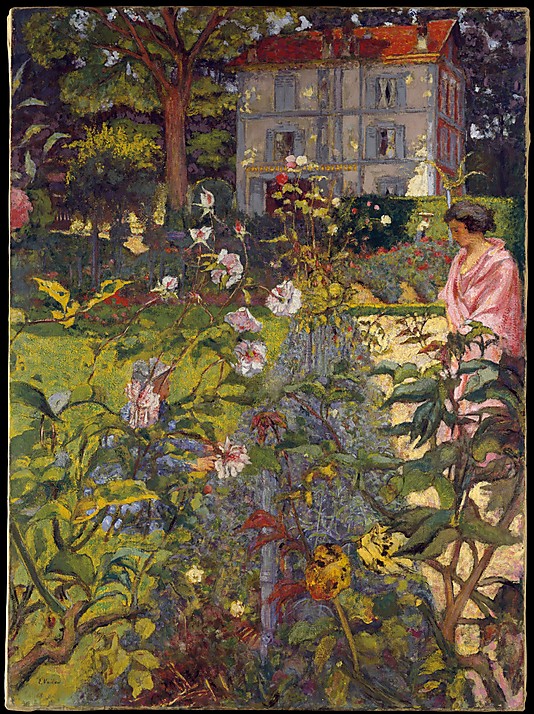
Re. Garden at Vaucresson by Edouard Vuillard: There is so much in this painting that fascinates. The sense of density and build-up, of thickness and tangle, which must surely result, in part, from the actual working technique, merges in a sense with the imagery itself. The high summer growth and quiet sunny heat of a private garden is brought forward and presses against the eye with an almost tapestry-like effect. Vuillard effectively cuts the sharpness of his high-keyed, modern palette by applying color over color, allowing the ground and subsequent paint layers to lend themselves, in total, to a more subdued effect. What, on its own, would be a rather acidic yellow-green is, instead, an intricate web of brushwork of muddy yellows, lime greens, and raw siennas, and in the right quarter of the image, a soft (nickel titanium?) butter yellow, quieted down and controlled with dull pinks and browns. Elsewhere, the effect of dappled sunlight and strong, cool shadows give definition to space and forms.
There’s a trick, of sorts, to this. The broken, rough edges of forms and shimmering touches of color all transmit the sense of sunshine and warmth. The plant growth in the foreground is formed with larger, bolder shapes and brushwork, bringing these forms closer to us. The lilac hedge that vertically divides the bottom half of the picture plane is a dense network of cool and warm violets, almost dusty purple in the shadows, and rising to grays that touch upon bluish-green in the sunlight. Getting up close to it, there is an almost disorienting handling of the brush here, like crewel-work.

Vuillard Garden
Garden at Vaucresson. Tempera (distemper) on canvas. 1920, reworked in 1926, 1935, 1936. Edouard Vuillard (French, b.1868-d.1940)